Charity Is Not Self-Government: Eatonville Must Stop Trading Sovereignty for Development
What's happening with the flooding, HostDime, the proposed museum, and the remaining Hungerford land isn't a handful of separate issues. It's what happens when a Black town loses control of the institutions and land that once made it independent.
By Julian Johnson · Published 2026-08-29 · 16 min read
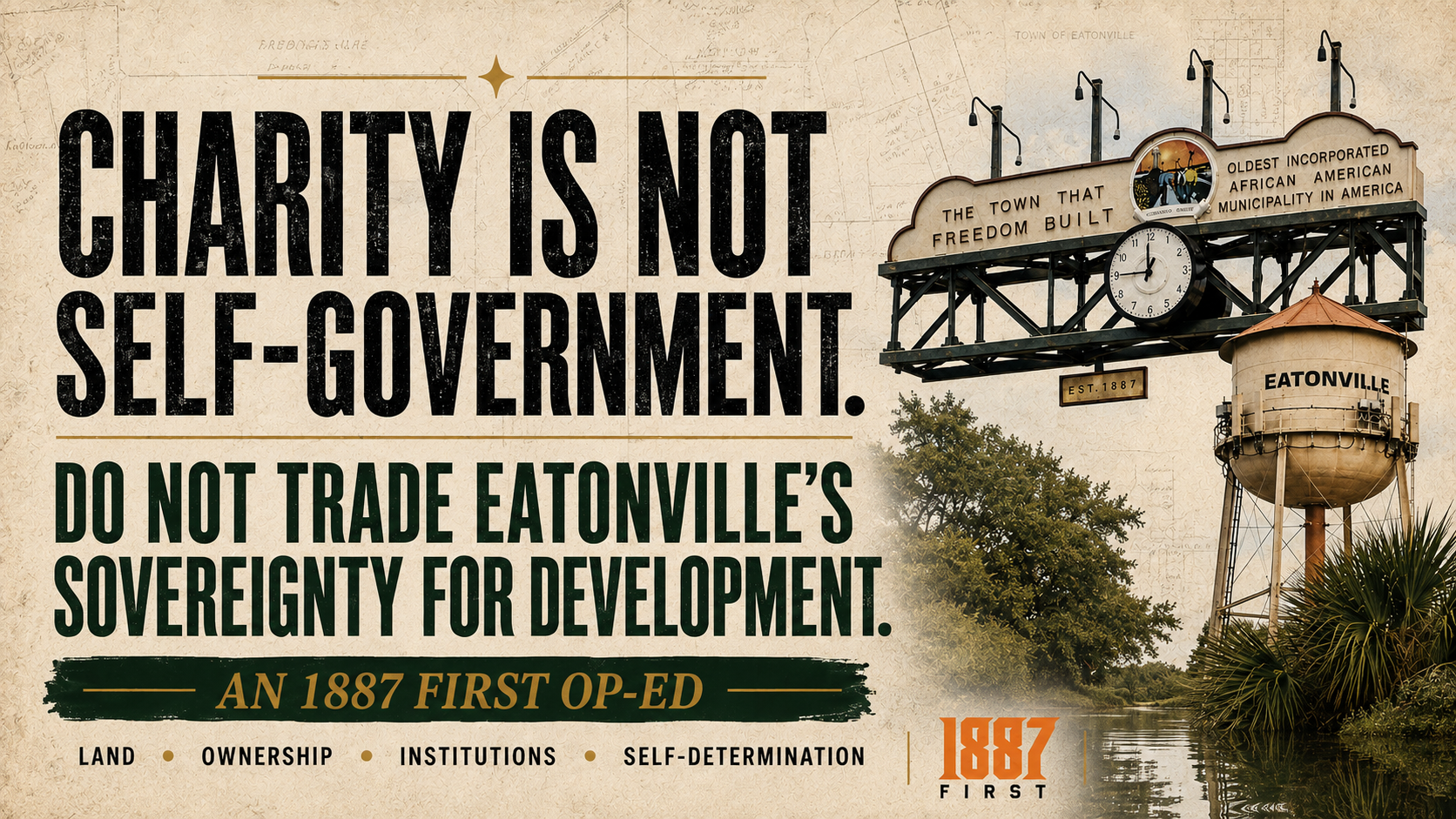
Editor's note: This is an opinion column from 1887 First founder Julian Johnson.
Nearly a year ago, Eatonville was underwater.
The Town Hall parking lot flooded. People paddled canoes through parts of Catalina Park. Water covered the streets near Kennedy Boulevard and Wymore Road. Homes took on water. Cars were destroyed. WFTV confirmed that the Kennedy-Wymore intersection was shut down by flooding on September 6, 2025.
Then the water went down, and Eatonville was expected to move on.
That's what people expect Black communities to do. Survive the damage. Clean up quietly. Call it resilience. Then show up smiling when somebody announces the next big plan for our future.
But resilience is not permission to neglect us.
We still don't have a full public account of where that water came from, what made the flooding so severe, which homes were affected, what damage is still sitting inside those homes, or who should be held responsible. We don't know how much of it was the storm, how much was an inadequate drainage system, how much came from construction near Wymore Road, or how long officials knew the system was vulnerable.
The flooding isn't separate from the Hungerford story. HostDime isn't separate from the Hungerford story. The proposed Dr. Phillips museum isn't separate from the Hungerford story.
All of it is happening on, around, or because of land that was once held for the education and advancement of Black children — and then taken out of the hands of the community it was meant to serve.
This is what losing control looks like
The Hungerford property was never simply 300 acres donated by one white family.
Mary and Russell Calhoun, two Black educators trained at Tuskegee, founded the school. The deeds we located show roughly 338 acres assembled from several families: about 120 acres from the Hungerfords; 80 acres from Black landowners Samuel and Mattie Moseley for $1; 40 acres from Black lawyer, physician, and community leader John T. Shufton for $125; 40 acres from the Cleavelands for $5; and about 58 acres from the Woffords for $3,500.
Black people weren't waiting for someone to save them. They were buying land, building a school, training children, and building an institution.
That was self-government.
In 1951, roughly 300 acres and the school's property were transferred, under court supervision, to the Orange County School Board for about $16,571. The land was supposed to keep serving the education of Black students, with an emphasis on vocational training.
Then the institution disappeared. Buildings came down. Restrictions were lifted. Parcels were sold off. The land became an industrial park, a highway project, a private development opportunity, and now the proposed site of an outside charity's museum.
People talk about the Hungerford takeover as if Eatonville simply lost acreage. We may have lost far more than that.
We lost control of an institution that could educate our children on the community's own terms. We lost land that could have supported businesses, trades, agriculture, housing, and industry. We lost a place capable of producing leadership and keeping talent, knowledge, and wealth inside Eatonville.
Once the institution was gone, Eatonville grew more dependent on outside school systems, outside employers, outside developers, outside funders, and outside organizations to provide what the town once had the land and institutional base to build for itself.
That dependency is now being mistaken for Eatonville's natural condition.
It isn't.
Self-government is bigger than Town Hall
Most people hear "self-government" and think of elections, Town Council meetings, or working for the municipal government.
That's only one piece of it.
Self-government also lives in the private and civic sectors. It's a Black-owned company contracting with the town. It's a community-controlled land trust deciding how land gets used. It's a local developer building without displacing residents. It's an independent school preparing children for the economy ahead of them. It's a community organization doing the research government wouldn't. It's a local media outlet telling the truth without waiting for permission. It's residents owning the businesses, buildings, intellectual property, and infrastructure that government depends on.
A community can't call itself self-governing if it elects its own officials while outsiders own its land, employ its people, control its institutions, interpret its history, and decide which projects are even possible.
Representation is not ownership.
A local person sitting on an outside organization's committee doesn't give Eatonville control of that organization. A resident landing a job inside an outside-owned project doesn't give the community equity in it. A public meeting doesn't transfer governing authority. A listening session doesn't create ownership. A museum carrying Eatonville's name doesn't become Eatonville's institution just because it sits inside the town.
Sovereignty is the power to decide.
It's the power to own land, form institutions, raise money, enter contracts, employ people, educate children, preserve history, run businesses, create knowledge, and say no when a deal costs more than it gives.
That's the power Eatonville has to rebuild.
HostDime shows what happens when benefits aren't secured early
Let's be accurate about HostDime. Its SuperNova facility isn't the same as a massive hyperscale AI campus draining enormous amounts of water through evaporative cooling. HostDime describes its project as a Tier IV enterprise cloud and colocation center built to support advanced and AI workloads, and says its closed-loop, air-cooled system recirculates water rather than continuously consuming it.
That may make HostDime a more thoughtful model than many of the data centers being dropped into communities around the country. But a company's intentional design doesn't erase the need for community power.
Residents still deserve independently verified facts about electricity demand, water use, generator noise, diesel storage, emissions, stormwater, traffic, emergency operations, and the strain on surrounding infrastructure. Backup generators keep a facility running through an outage — they don't make it independent of the public electrical grid.
The harder question is what Eatonville actually secured back when it still had the strongest negotiating leverage.
In 2016, the community heard about jobs, tax revenue, $1 million for scholarships, and free Wi-Fi throughout Eatonville. But what exactly was guaranteed?
"Free Wi-Fi" sounds powerful until you look for the details. Public Wi-Fi isn't necessarily reliable home internet. It can mean limited coverage, weak indoor signal, speed caps, filters, device limits, privacy concerns, and expensive upkeep. Somebody has to own the network, replace the equipment, secure the data, pay for backhaul, and stay accountable when the service fails.
A promise says "free Wi-Fi."
Community power puts the coverage, minimum speed, ownership, maintenance, funding, privacy protections, enforcement, and duration into a binding agreement.
A 2016 news report said the Wi-Fi and scholarship commitments were written into the developer agreement. We couldn't find those commitments in the copy of the agreement we reviewed. If they exist in a separate agreement, resolution, memorandum, or enforceable instrument, release it. If they were only discussed publicly and never legally secured, say so plainly.
The town also put up to $200,000 toward project infrastructure. Years past the original projected opening, the facility still hasn't received its certificate of occupancy. Recent Town Council reporting points to a $250-per-day penalty accruing, while other public documents show different proposed penalty terms.
So which agreement controls? How much is owed? How much has been collected? Where is it going? Which promises are still enforceable? What can still be negotiated before occupancy?
Fiscal responsibility isn't bragging about future tax revenue. It's knowing what the public gave, what the private company promised, what actually got delivered, and what happens when deadlines are missed.
This isn't an argument against HostDime. It's an argument against Eatonville walking into another major deal without independently measuring the cost, the benefit, and the power changing hands.
The flooding exposed more than a drainage problem
Orange County's proposed Lake King Stormwater Infrastructure Project tells us the existing system needs a major overhaul. The project would replace one 36-inch drainage pipe with four, running roughly 10,950 feet toward outfalls between Lake Lovely and Lake Shadow. It would clear vegetation blocking stormwater flow, add retention basins and rain gardens, acquire 8.62 acres, and excavate about 42,000 cubic yards to increase storage.
If one pipe has to become four, when was that lack of capacity discovered?
If vegetation has been blocking stormwater flow, how long was it allowed to sit there?
If construction around Wymore Road contributed to the drainage problems, who approved it, and who's responsible for fixing it?
If homes flooded, who's checking what happened inside them?
The Centers for Disease Control and Prevention says a flooded home that can't be dried within 24 to 48 hours should be presumed to have mold growth. Yet residents are often left to cover those costs privately while government debates infrastructure in public.
The same pattern shows up in Eatonville's water lines. Residents know about the breaks and interruptions. What we don't have is a full public accounting of pipe age, break locations, repair costs, replacement schedules, and whether the system can even handle everything being proposed for it.
Developers study what their developments require. Eatonville needs to study what its people require.
Charity comes with a tradeoff
Now Dr. Phillips Charities is advancing a sweeping plan touching stormwater, roads, utilities, a park, early learning, healthcare, housing, retail, offices, a Town Hall, and an Eatonville Museum of Culture & History.
Those are attractive words. The problem isn't that every idea is bad. The problem is who owns the plan, who controls the land, and who holds the power once the ribbon is cut.
There's a trade being offered here: outside capital and institutional credibility in exchange for outside control.
That's the part people are afraid to say out loud.
Charity can provide services. Charity can contribute money. Charity can be a partner. But when a charity owns the land, controls the board, picks the leadership, holds the intellectual property, manages the revenue, and decides how a Black town's history gets told, the community has traded sovereignty for assistance.
That may still produce attractive buildings. It may produce programs. It may create some jobs. It may even improve infrastructure.
But it doesn't produce self-government.
On August 25, the Orange County Board of County Commissioners accepted the Tourist Development Tax task force's recommendations and directed staff to move forward with the recommended projects. Dr. Phillips Charities' $60 million museum request advanced, but the final appropriation, amount, schedule, and conditions still have to come back for later decisions.
That means the public still has time to demand answers.
Who will own the museum? Who will appoint and remove its board members? Who will own the collections, archives, recordings, trademarks, and other intellectual property? Who decides which version of Eatonville's history gets presented?
How much voting power will residents, descendants, and community institutions actually have? Which contracts will go to Eatonville businesses? Will local participation be guaranteed, or just encouraged? What percentage of the money generated stays inside Eatonville? What happens if the promised benefits don't materialize? What stops residents from being displaced once outside investment drives up the value of the land around them?
If the institution sits in Eatonville and carries Eatonville's name, but somebody else owns it, governs it, and controls its story, then it's Eatonville in name only.
Community engagement can't fix that by itself. People can sit through meetings for two years and still walk away without authority. They can be heard and still be ignored. They can be thanked for their input while the ownership structure never moves an inch.
We should want more than our voices heard.
We should demand power in writing.
Eatonville needs its own evidence
Dr. Phillips Charities or any other project sponsor may commission an economic-impact study. That study might contain useful information. But a sponsor's study will naturally be built around the sponsor's proposal.
Eatonville needs a study built around Eatonville.
If Georgia State University or another institution has been retained, release the contract, scope, methodology, assumptions, funding source, and data. Let the public see whether the study measures ownership, wealth leakage, infrastructure costs, environmental risk, displacement, and local control — or only visitors, construction spending, and projected jobs.
The Ville CDC is calling for an independent Community Infrastructure, Health, Environmental and Economic Impact Study — governed with the community and free from the control of any developer, charity, political faction, or institution whose actions need examining.
It should document what caused and worsened the September 2025 flooding; which homes and businesses were affected, and what health and property damage remains; the condition and capacity of Eatonville's drainage, water, and sewer infrastructure; HostDime's actual water, energy, noise, generator, emissions, and stormwater performance; every public contribution, penalty, and promised benefit connected to HostDime; the cumulative effect of the museum, housing, roads, utilities, and remaining Hungerford development; who will own the land, buildings, businesses, collections, and intellectual property; how many permanent jobs will exist, what they'll pay, and how residents qualify for them; how much revenue and wealth will actually stay in Eatonville; and how the School Board's control and disposal of Hungerford land affected education, business formation, leadership, homeownership, employment, and community institutions.
The raw data has to be public. Residents have to help shape the questions. And the results have to arrive before the agreements are finished — not after all the power has already changed hands.
That's what we should be raising money for.
Not another meeting where somebody explains their vision to Eatonville. Evidence that lets Eatonville build, negotiate, and defend its own.
Black communities need more than inclusion
Eatonville doesn't need to be included in somebody else's future.
It needs the power to build its own.
That takes more than government employment. It takes a private sector rooted in Eatonville, capable of working with government as an equal partner. It takes Black-owned contractors, developers, farms, media, technology companies, research institutions, schools, lenders, cultural organizations, and landholding entities.
Government is one center of power. It shouldn't be the only one.
When every opportunity, contract, job, grant, and introduction has to pass through the same few political, church, business, or family relationships, people become dependent on access instead of protected by transparent institutions. Independent leadership starts getting treated as competition. Silence gets mistaken for unity. Compliance gets called community.
That's not self-government either.
A healthy Black community has more than one center of power. Its people can question the town without losing access to the church. They can question the church without losing business. They can challenge a charity without being accused of rejecting help. They can criticize a developer without getting labeled anti-growth. They can build independent institutions without asking established leaders for permission.
Eatonville was incorporated because Black people wanted authority over their own lives.
We dishonor that history when we reduce self-government to holding office while giving up the land, the economy, the education, and the institutions that make governing possible in the first place.
We are not giving away empty land
Eatonville will survive. It's survived for 139 years.
But survival isn't enough.
The remaining Hungerford land isn't an empty canvas. It carries the labor, sacrifice, and unfinished intentions of people who assembled land for Black education and advancement. Whatever gets built there will shape what Eatonville's children can own, learn, create, and control.
When we give away the land without securing power, we're giving away part of their future too.
We don't need another savior. We need partners who respect that Eatonville is a government, a people, a market, a history, and a living Black community — not a charitable project.
We are not against development. We are against development that requires surrender.
We are not against a museum. We are against Eatonville becoming the exhibit while somebody else owns the institution.
We are not against charity. We are against charity being used as a substitute for justice, ownership, and self-determination.
Eatonville needs its own evidence. Its own businesses. Its own institutions. Its own land strategy. Its own sources of capital. Its own ability to work with government from the private sector. Its own power to say yes, no, or not under these terms.
That is self-government.
And after 139 years, Eatonville shouldn't have to trade it away just to be considered worthy of investment.
Sources and documents
- WFTV coverage of the September 2025 flooding
- Orange County notice for the Lake King Stormwater Infrastructure Project
- CDC guide to mold cleanup after flooding
- HostDime overview of its Tier IV facility
- HostDime explanation of the SuperNova facility's closed-loop cooling system
- 2016 reporting on the HostDime project and promised benefits
- Recent reporting on HostDime's unfinished facility, drainage concerns and disputed penalties
- Dr. Phillips Charities' August 2026 Eatonville Initiative update
- Central Florida Public Media report on the August 25 Tourist Development Tax action
Corrections and updates
No corrections have been issued for this story.
Support the work
Fund the Eatonville Truth & Impact Study
Your gift supports independent research, records requests, and publication. Zeffy passes 100% of your donation to the work.